

Changing dynamics
Has agentic delivery changed what your teams spend their time on?
AI coding tools are changing the value dynamics of software delivery. At Procurify, we are an AI-native engineering organization. Our focus is progressively shifting towards defining the systems that deliver our software, instead of delivering the software itself. The cost of delivering software has never been lower. Our throughput has never been higher. In fact, in the past year, we've seen a 175% increase in deployments to production.
As AI agents take on an increasing number of activities within our software development lifecycle (SDLC), the tasks that engineers work on within that process have changed. Engineers spend less time writing code for review, and more time reviewing code produced by coding agents.
As we started to move into this new world of agentic delivery, we saw an opportunity unfold within our DevSecOps team.
The opportunity
I work on the DevSecOps team at Procurify. As is the case with any DevSecOps team, we produce work items that get added to teams' backlogs for prioritization. Examples of this are performance improvements, routine maintenance, and other ongoing enhancements. To ensure this work has a chance of being prioritized when compared against the other items in the team's backlog, we need to define the value for the team to consider when prioritizing.
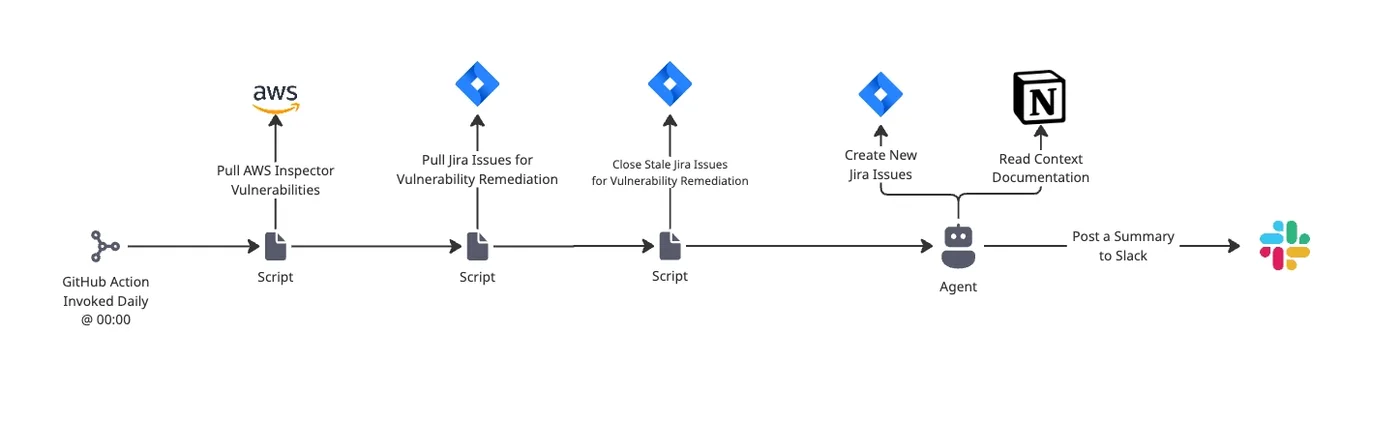
Initially, we focused on specification. We used agents to define the work that was required to be done. Automations ran on schedule to define the next batch of surfaced tasks and added them to the teams' backlogs. We were outputting better-scoped, consistently defined tasks.
Then we asked ourselves, why were we pushing these work items to teams' backlogs? We could use our coding agents to implement the work. Instead of adding items to a team's backlog for prioritization, we were automating the implementation too and pushing PRs for teams to review.
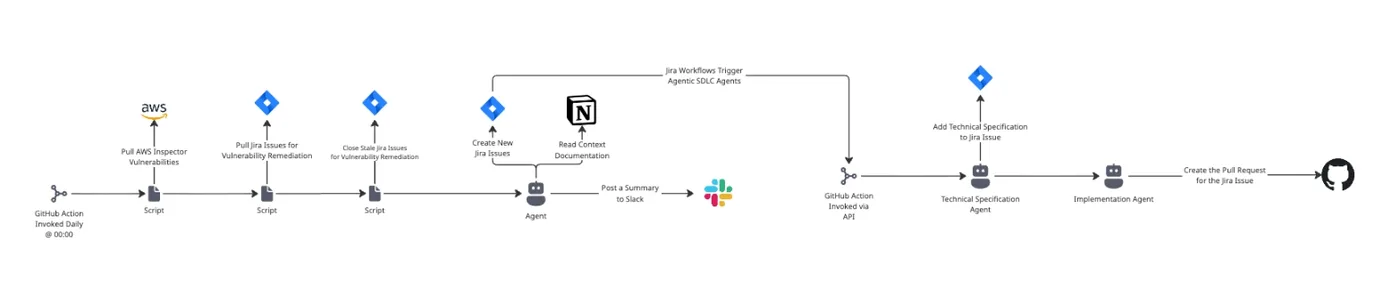
Every night we would publish a selection of PRs for review that addressed newly found issues. And every day the PRs would sit there, unreviewed, becoming more stale. Huh? 🤔
What did we miss?
What did we miss? Strategy!
If a team's engineers are now spending most of their time reviewing code, there's no advantage in us having agents deliver that work on behalf of the team for review. It's up to the team to determine when the work should be prioritized for the agents to deliver, and they'll review it then. Why? Because we have a strategy! That strategy dictates the time we spend on different aspects of our codebase. Where we spend our time working has changed, but that doesn't mean what we spend that time working on should change.
Aligning to strategy
In engineering at Procurify, all work items are allocated to a bucket that classifies the type of work being done. We use this to measure the time teams spend working within each allocation. Over time, as our strategy changes at Procurify, we adjust how much time we wish to allocate to each bucket.

In our example, we'll classify the DevSecOps-sourced work as M (maintenance).
As we adopt the Agentic SDLC, we can ensure that we are staying aligned to our strategy.
If the current allocation results in an engineer's weekly allocation looking like this:

If coding agents double the throughput, the allocation should look like the above allocation x 2:

In our case, sending through M PRs could make the PR queue look like this:

However, aligning to our strategy, the prioritization of these reviews will look like this:

And as more and more Ms are generated by our team, they will be appended most likely to the bottom of the list and become increasingly stale. Just because we have generated a PR doesn't mean that a team should adjust its allocation of work.
Initializing our Agentic SDLC
We realized that to integrate agents into our current process and stay aligned to our strategy, we needed to give teams an interface for operating the agents we used in our automations. This became the foundation for our internal Agentic SDLC, a self-serve way for teams to run our coding agents against their own backlog, on their terms and within their strategic allocation. Now rolled out across our R&D organization… more on that to come in upcoming posts.
Coding agents have accelerated delivery. But acceleration without direction doesn't get you to your goals faster. Strategy is your direction.
So, back to where we started: has agentic delivery changed what your teams are spending their time on?
If you're not tracking this, you should be! It's lightweight, and could be the difference between accelerating into a build trap or accelerating in the right direction.